

Archive for 2013
Social Media: What’s it Good For?
Does social media drive sales?
I’ve been asked this question quite a few times lately from business owners trying to get their head around how to use social media in their online marketing mix. Many of them tell me that they don’t see a direct return on investment from their use of Twitter, Facebook and other social networks.
In response, I thought I’d jot down a few thoughts on how social media benefits what I do. Keep in mind, there’s no right or wrong way to use social media. I know of many online and offline businesses that use social media very differently.
For me Social Media is NOT Primarily about Direct Selling
Perhaps the biggest thing that I can say about how I’ve come to use social media is that I don’t see it as a primary avenue for selling.
I know some online businesses see substantial sales generated directly through their social media pages. In most cases, it is through offering coupons or running discounting sales. That said, the tests I’ve run have not seen a great deal of success.
In contrast, I see the vast majority of our sales of eBooks and events to be the result of our email marketing.
In a recent eBook launch, here’s a break down of where sales came from:

Interestingly, over the 4 week launch of that eBook we sent/posted:
- 4 sales emails
- 3 blog posts
- 17 Tweets
- 5 Facebook Status Updates
- 3 Pinterest Pins
- 2 LinkedIn Updates
- 3 Google Plus Updates
As you can see, we promoted the eBook quite a few times to our social networks. Those social networks have a combined reach of over 350,000.
In the same time we sent 4 emails (to around 700,000 people). The ‘return’ on sending a handful of emails far outweighed the effort in social.
That’s not to say we will stop doing sales related updates on social media – (there are ways to use it to sell) – it just isn’t our primary sales avenue.
Social Media – What is it Good For?
So social media hasn’t generated as many direct sales as other channels, and my business relies upon sales to be sustainable, so what is it good for?
I do invest a fair amount of time (and some money) into social media but for me, it is not a direct sales strategy.
Rather social media is largely about:
- Building the Brand – by being useful, telling stories, answering questions, giving glimpses behind the scenes
- Building Community and Engagement – asking and answering questions, listening to feedback, supporting the goals of those you connect with
- Building Trust and Credibility – by showing you know what you’re talking about and an understanding of the niche you operate in
- Driving Traffic – sharing links to new content (and highlighting the best bits in the archives)
By building a presence in places like Twitter, Facebook, Google+, LinkedIn (and more you) you create relationships with and create impressions upon those you connect with.
Those relationships may not directly lead to a sale but they have other powerful outcomes.
They all have an indirect long term positive impact upon the the bottom line of your business. In many ways, by building brand, engagement, trust and driving traffic you are building the foundations of a strong relationship.Once the time for selling comes, you’re much more likely to see a conversion at some point.
They also make business a lot more satisfying and fun to run!
Journey to $500/day with Amazon and AdSense
Okay guys you must be thinking that this is another newbie who is dreaming to earn this much amount per day and most certainly he’ll not. But no, I just won’t stop until I make $500 per day. Currently I’m earning about $120/day with Amazon and AdSense together from 6 websites. I don’t plan on making more websites but to focus on these 6 only.
Here’s couple of screenshots for those (pics or it didn’t happen) guys


First I’d like to tell you that this journey has already been started on 1st march, I worked about 8-9 hours every day including Sundays in March and April but for some reason I've become lazy and I haven’t done anything in last 20 days other than checking my stats/earnings. That’s the main reason to start this journey. I just want to work and report it somewhere, so I’ll be reporting my work here in this thread.
Investment:Not much and main reason for that is I don’t have a credit card and without that Indians can’t pay to anyone or buy anything from PayPal. I found a guy who did let me use his credit card for 10% extra cash to buy hosting and domain names. So that’s all I have:
10 .com domains from GoDaddy (used coupons)
3 Years HostGator Hosting (I got 25% discount)
Sorry for not mentioning prices, I don’t remember the exact prices but I guess you’ll get the idea and they were in INR anyways.
Skills I’ve got:
Wordpress
Basic HTML
Article Writing (got enough strength to write about 5k words/day)
Keyword Research (I believe I’m good at it and that’s the reason for my success so far)
On page SEO (I’m good at this too, thanks to wordpress SEO Yoast plugin)
Off page SEO (still experimenting and learning)
Tools:
No tools, I do everything manually like guest posts and web 2.0’s and will be buying SerpBook subscription next month. Currently I’m using free keyword rank tracking tool from smallse0t00ls.
Threads from where I’ve learnt:
Amazon: http://www.blackhatworld.com/blackha...-good-bad.html
Danny1111 has talked about everything you’ll need to know to earn from Amazon in this thread and there are also few SEO tips in there. One thing I can tell you is that without this thread, I wouldn’t be earning anything and most probably would be still wasting my time on YT/PPD.
Another Amazon Thread: http://www.blackhatworld.com/blackha...n-journal.html
Well, this is the thread that made me start my own Amazon sites and there’s lot you can learn in this thread too. Thank you maecenas23.
SEO: http://www.blackhatworld.com/blackha...te-google.html
I have read plenty of threads about SEO in last 6 months, but this thread from Kimi made me take action and with a little twist of my own I was able to rank keywords with 3-5k exact match on first page. First thing I do every morning is, open BHW and read Kimi’s posts because that’s what I think it takes to learn SEO.
Another SEO Thread: http://www.blackhatworld.com/blackha...ghts-kimi.html
Haven’t read this fully because I am already in the process of executing a new SEO strategy and don’t want to change my mind after reading it. Once I’m done with it then of course I’ll read it plenty of times to understand it completely.
My sites are kind of niche targeted websites where I write reviews, how-to articles and news.
Well, I guess this much information is enough and here in this thread I will be reporting my daily work of articles written for my money site and links created towards them. If you have questions feel free to shoot them, I’ll give my best answers but please don’t ask about confidential stuff like niches or products I’m targeting.
Here’s couple of screenshots for those (pics or it didn’t happen) guys


First I’d like to tell you that this journey has already been started on 1st march, I worked about 8-9 hours every day including Sundays in March and April but for some reason I've become lazy and I haven’t done anything in last 20 days other than checking my stats/earnings. That’s the main reason to start this journey. I just want to work and report it somewhere, so I’ll be reporting my work here in this thread.
Investment:Not much and main reason for that is I don’t have a credit card and without that Indians can’t pay to anyone or buy anything from PayPal. I found a guy who did let me use his credit card for 10% extra cash to buy hosting and domain names. So that’s all I have:
10 .com domains from GoDaddy (used coupons)
3 Years HostGator Hosting (I got 25% discount)
Sorry for not mentioning prices, I don’t remember the exact prices but I guess you’ll get the idea and they were in INR anyways.
Skills I’ve got:
Wordpress
Basic HTML
Article Writing (got enough strength to write about 5k words/day)
Keyword Research (I believe I’m good at it and that’s the reason for my success so far)
On page SEO (I’m good at this too, thanks to wordpress SEO Yoast plugin)
Off page SEO (still experimenting and learning)
Tools:
No tools, I do everything manually like guest posts and web 2.0’s and will be buying SerpBook subscription next month. Currently I’m using free keyword rank tracking tool from smallse0t00ls.
Threads from where I’ve learnt:
Amazon: http://www.blackhatworld.com/blackha...-good-bad.html
Danny1111 has talked about everything you’ll need to know to earn from Amazon in this thread and there are also few SEO tips in there. One thing I can tell you is that without this thread, I wouldn’t be earning anything and most probably would be still wasting my time on YT/PPD.
Another Amazon Thread: http://www.blackhatworld.com/blackha...n-journal.html
Well, this is the thread that made me start my own Amazon sites and there’s lot you can learn in this thread too. Thank you maecenas23.
SEO: http://www.blackhatworld.com/blackha...te-google.html
I have read plenty of threads about SEO in last 6 months, but this thread from Kimi made me take action and with a little twist of my own I was able to rank keywords with 3-5k exact match on first page. First thing I do every morning is, open BHW and read Kimi’s posts because that’s what I think it takes to learn SEO.
Another SEO Thread: http://www.blackhatworld.com/blackha...ghts-kimi.html
Haven’t read this fully because I am already in the process of executing a new SEO strategy and don’t want to change my mind after reading it. Once I’m done with it then of course I’ll read it plenty of times to understand it completely.
My sites are kind of niche targeted websites where I write reviews, how-to articles and news.
Well, I guess this much information is enough and here in this thread I will be reporting my daily work of articles written for my money site and links created towards them. If you have questions feel free to shoot them, I’ll give my best answers but please don’t ask about confidential stuff like niches or products I’m targeting.
Content Creation vs Content Promotion: Where is the Balance?
A few days ago we published a post on ProBlogger9 titled ‘Forget about Marketing: Concentrate on Blogging‘, which led to some interesting discussion on Twitter and in the comments.
I love the points author Nicholas Whitmore made in the post but I wanted to give a few thoughts, based on my own experience, on developing great content and promoting your blog.
Nicholas wrote some great arguments for focusing your energy on writing great content as the central way of growing your blog. He writes:
I completely agree with this sentiment. As a blogger your #1 focus needs to be on producing content that is useful, engaging and of as high a quality as possible. Without it, all the marketing you might do will be wasted as you’ll just be directing people to something that is of no value to them.
As Nicholas goes on to write:
Again, I agree with the sentiment expressed here.
However, on Twitter a discussion among some of my followers highlighted that some bloggers differ quite a bit on how much effort should be put into promoting a blog vs developing content for it.
- On one hand, there were certainly people who felt that if you build a great blog that it markets itself.
- On the other hand, there were people who felt that if you didn’t get out there and market your blog you ran the risk of all your hard work in developing great content going completely unseen.
While I think we all agree that the content on your blog needs to be of a very high focus, I’m also of the belief that if a blogger wants to grow their readership they also need to put effort into promoting that blog.
I like the idea of the marketing being taken care of by your visitors, if you have good enough blog post. In my experience, there are things you can do to promote your blog to help speed the process up, without compromising the quality of your posts.
In the early days of my own current blogs (here on ProBlogger9 and at dPS) I estimate I probably spent almost as much time writing content as I did working on growing the readership. In fact, I’m sure there were some weeks where I did spend considerably more time promoting my blog than writing content!
In short, I don’t see marketing and creating content as mutually exclusive – both are really important to me.
How did I grow my readership (or market my blogs)?
I recorded a webinar last year on this very topic with a load of tips in it. You can listen to it and see the slides here so I won’t rehash all of that but here’s a summary slide of the points I talked through.
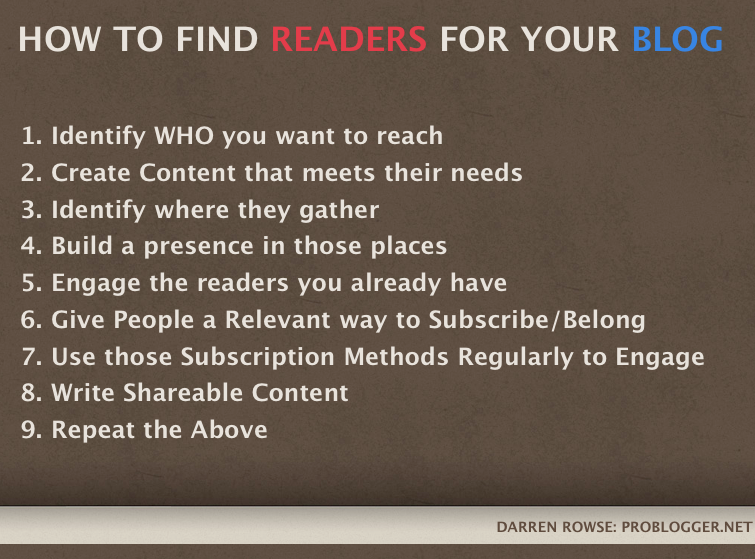
You can see that my process actually talks about the content that you develop as being a part of finding readers for your blog (both in points 2 and 8). But by getting off your blog to promote what you do you are certainly able to significantly grow your blog.
For me, I’d say that the balance of creating content and promoting has changed over the life of my blogs over the years. This is probably partly because the life cycle of a blog but also due to my own personal circumstances and how much time I have available to work.
That said , I would always prioritise both on a daily basis… and would probably also add in that I prioritise other things too such as ‘engaging with readers/building community’ and also a focus upon ‘monetization’ (without which I can’t sustain what I do).
Where is the Balance of Promotion and Content Creation for You?
I’d love to hear how others get this balance right in your blogging?
Search Engine Ranking Factors
Steve Rubel points to a useful resource over at seomoz on Search Engine Ranking Factors which is one of the better descriptions of how Search Engines rank pages that I’ve seen recently. It lists 93 factors to keep in mind. Sounds like a lot to remember – so luckily they’ve arranged them into different levels of importance (only problem is that on all three of my Mac browsers the symbols that tell what is important or not don’t seem to be working at the moment).
Check How Many Google Subscribers You Have
 I’m not sure when this happened but King Nomar just let me know that Google have added a tool to their Webmaster Tools that allows you to check how many subscribers your RSS feeds have in Google’s feed readers (iGoogle, Google Reader, Orkut).
The numbers reported only count Google subscribers – but it’s interesting that Google are now tracking this information (makes me wonder how long it’ll be before subscriber numbers are used in their search algorithms (if they’re not already).
What I’m not sure is how this treats subscribers through feedburner feeds if you don’t have a feed on your domain. From what i can see the number in Webmaster tools is significantly less for me than what Feedburner reports my Google subscribers as (Google reports it at less than half what Feedburner does for Google subscriber numbers).
3 Ways to Get More Subscribers for Your Blog
“I have hundreds of readers coming to my blog every day – but nobody ever subscribes to my newsletter. Help!?!”
This request came in via email today and I thought I’d share my reply with the 3 suggestions I offered.
—–
Thanks for the question – I suspect you’re not alone with this problem. While a lot can probably be written on the topic, let me suggest 3 things I’ve found helpful increasing subscriber numbers.
Note: the #1 thing I did to building subscriber numbers on Digital Photography School was introduce a lightbox subscriber box. I spoke about this in my 10 Things I Wish I Knew About Blogging webinar so I won’t rehash it here.
1. Ask People to Subscribe
This sounds a little too simple to be effective but I’m amazed how many people do subscribe once you mention you’ve got a newsletter. I’m also amazed how many of our regular and loyal readers don’t know we even have a newsletter, despite it being promoted around the blog.
Some semi-regular calls to subscribe can be very effective.
You can do this in a number of ways, including:
- Writing a dedicated blog post, every now and again, explaining you have a newsletter and the benefits of subscribing.
- Mentioning your newsletter in passing in your blog posts. I don’t mean every single post, but a mention now and then will work wonders.
- Promoting your newsletter across social media. I regularly mention our newsletters on Twitter, when I’m writing a newsletter and when it goes out.
The key to remember, when mentioning your newsletter regularly, is to find fresh ways to talk about it. Don’t just have the same tweet to subscribe every 2nd day.
- Mention something that is in the next newsletter, that you won’t get anywhere else.
- Mention that you’ve just hit a milestone number of subscribers to build social proof.
- Mention that it’s a milestone newsletter. We recently sent out 250th on dPS and made a bit of a big deal about it.
2. Start a Series
Announce that you’re going to be doing a series of posts, on your blog, on a topic that you know will really be useful to your readers.
I remember the first time I announced that I was going to run the 31 Days to Build a Better Blog series (the series that later became the eBook by the same name) I was amazed at how many people subscribed to my blog over the next 24 hours.
I was signalling to readers that I was going to do something that would serve them and in doing so, created anticipation among my readers. This anticipation (as I’ve written about in the past) is a key reason people will subscribe to your blog.
3. Place Calls to Subscribe in ‘Hot Zones’
One last tip is to identify some ‘hot zones’ on your blog, to place calls to subscribe. These zones are either places that your readers will be looking or pages that they’ll be visiting.
Let me suggest a couple:
1. Under Posts
I’m not currently doing this on my blogs, as I use the space under my blog posts for other things, but I’ve found over the years that the area under your blog post (and directly above comments) is a ‘hot zone’ where readers often look for what to do next.
Put yourself in the position of a reader. You’ve read the post and have found it useful. This is the perfect time to ask readers to subscribe because they’re hopefully feeling satisfied, stimulated and helped in some way.
A bold call to subscribe can work wonders here.
2. On Hot Posts
Dig into your blogs analytics package and identify which posts are the most read posts on your blog.
You’ll probably find that these posts are receiving traffic from search engines and are likely being read by first time readers to your blog – people that are often quick to leave again once they’ve got what they’re searching for.
These posts are a real opportunity to make your blog a little more sticky and to hopefully call some of those first time readers to subscribe.
You can do this either by adding a call to subscribe directly to the posts – or you might like to link from these posts to a ‘sneeze page’ (see below).
3. Sneeze Pages
 Let me show you a page on dPS, which is a page that generates a large number of subscribers. It is ourPhotography Tips for Beginners page.
This page is a page in which I link to 33 of the best articles in our archives for beginner photographers. It is a page that ‘sneezes’ readers deep into our archives to good quality content.
It is a great page for driving traffic and getting readers deep into the site but you’ll also note we have a couple of strong calls to subscribe on that page. People click those calls to action like crazy because they can see on the page that we’ve created a heap of useful content.
We link to this sneeze page prominently in the navigation areas all around the site to drive traffic to it and regularly promote the page on social media (as I write this it has received over 90,000 ‘pins’ on Pinterest for example).
Take home lesson – create a sneeze page with a strong call to action to subscribe and drive as much traffic to it as you can!
Note: Sneeze pages are written about on day 18 of 31 Days to Build a Better Blog.
How Have You Increases Subscribers to Your Blog?
I have barely scratched the surface here on how to increase subscribers to a blog and would love to hear your suggestions and experiences on the topic in comments below.
What has worked for you?
5 Ways to Make Money Blogging (Once You Have Traffic)
Making Money From a Blog – Moving Past AdSense
While it is possible to make some money with a blog of any size – your chances of earning income from a blog do generally increase as you increase your readership numbers.
Many bloggers start out monetizing their blogs using ad networks like AdSense. While ad networks like AdSense can still earn you a nice income as your blog grows (many large blogs use them) – an increased audience will also open new opportunities to you as a blogger.
1. Direct Ad Sales
One thing that becomes possible as your readership grows is that you can begin to attract your own direct advertisers.
2. Ad Representation
Many bloggers struggle to sell advertising on their own blogs. Most bloggers are not experienced in the area of ad sales, don’t have contacts in the advertising industry, are unaware of how much to charge or even what technology to use to serve ads. Most of us also are passionate about writing content and building community – the admin of finding and interacting with advertisers can often be a distraction.
One alternative once you have a reasonable amount of traffic is to outsource your ad sales. Some blog networks and ad networks will handle this kind of thing for you once you have enough traffic. Generally you need a fair bit of traffic for them to look at you but in these tough economic times I suspect we’ll see more and more services to do this.
3. Start Your Own Ad Sales Network
One thing that I’ve been hearing more and more bloggers doing is joining together to sell advertising as a collective or network within a niche. You might not have enough traffic to attract a top tier advertiser alone – but what if you joined with 4-5 other medium sized blogs in your niche and approached advertisers together?
4. Affiliate Marketing
Affiliate marketing can work on blogs of all sizes but once a blog has an engaged and loyal readership it can really pay off. Readers that have tracked with you for a while are more likely to buy something that you recommend than a one off visitor – so this is a particularly useful strategy if you have built a ‘community’ rather than just a blog that has a lot of search traffic. The key is to find products to promote that are of a high quality that you can genuinely recommend and that have high relevance to your readership.
5. Sell Your Own Product
Another monetization strategy to start thinking about once you start seeing growth in your readership is your own product to sell.
Whether that product be an e-book, a membership area, a real hard cover book, training (online or real life), consulting, merchandise…. once you’ve got a loyal readership who trusts you and sees you as an expert in your field you’ll find that they are increasingly likely to buy something that you sell.
You’ll also find it easier to get other blogs in your niche to promote your product once you’ve build a blog with profile. I’m seeing more and more bloggers doing this and suspect that as advertising budgets get smaller in the current economic climate that we’ll see more and more of this type of approach (I’ve previously called it ‘indirect income’) by smart bloggers.
10 Ways to make your Blog more Attractive to Advertisers
1. Have an “Advertise with Us” Banner on your site
This is the single most important issue. It should click to an Advertising information page and have an easy way to contact you for more information and rates. Key points: Make it a graphical image or a tab. Keep it above the fold.
2. Keep the ads on your site specific to your site
Don’t have smiley ads and wallpaper ads if your site is site is about mobile phones.
3. Show them the banners
If you currently have no paid placements on your site, put up house ads or partner ads in the same spot you would run a paid spot. (A house ad refers to banners for other products or sites that you or your company own)
4. Throw up a free bonus ad.
By putting a free advertisement on your site, you may not only encourage similar ads or competitors to that product, but the company you added for free may decide to advertise with you. Ask for full disclosure of the performance of the campaign in return. (Total clicks, total purchases etc. ) Key points. Put the free bonus up with a direct URL without tracking tags or affiliate tags.
5. Show your site stats.
You need to show at least the basics for site statical information: Monthly unique visitors and total number of impressions are the 2 key ones. Other less important can be Google PR & Alexa rank.
6. User demographic information. Know your audience.
The bare minimum is Male/Female % and average age of your readers. Other potentially useful information includes geographic, HHI, single/married, number of kids. etc. How do you get this info? You can do site polls, survey’s, or get more detailed stats from ComScore or Quantcast.com
7. Have an ‘About Us’ section.
Clearly explain who you are and what your site is about. And also why you are an ‘authority’ on what you are writing about, and why anyone should care about what you have to say.
8. Don’t use Google AdSense on your site.
OK, this could be the most painful one for most people especially if you are generating a few hundred bucks a month from it already. But Google ad sense devalues your site and makes it look unprofessional. You have to ask yourself, “Do I want some real revenue from my site or Google’s table scraps.”
9. Keep your blog on topic.
If you are all over the map in regards to topics about which you talk about, advertisers won’t know if they are a good fit for your site.
10. Keep your blog professional.
If you are talking about your cat, (Matt Cutts), ranting about your drive to work, swearing or bashing every product you can think about, it will scare away advertisers.
Forget about Marketing: Concentrate on Blogging
Well, recently it seems like a lot of bloggers fancy themselves as marketers. You can’t read a post on a blog without seeing a load of other bloggers commenting at the bottom, with a link back to their own site. Of course other bloggers use black hat SEO tricks and other shady tactics in order to drive traffic to their blog. Each to their own you might say, but at the end of the day life can be much, much easier.
If you publish blog content that’s truly awesome, everyone else will market your blog for you.
If you seem to spend half your life trying to promote your blog with your efforts never coming to fruition, now’s the time to stop. There’s a reason why things aren’t working out – and you can bet your bottom dollar that it’s the actual content in your blog posts.
Sorry to have to break it to you, but your blog posts suck.

It’s time to go back to basics because if you’re guilty of trying to build links and force traffic to your blog, you’re trying too hard.
The art of blogging involves thinking up great topics and blog titles, performing research where required, then authoring great work.
Building links and driving traffic to your website does not fall under the blogging remit – that’s marketing, something different altogether.
Good things come to those who wait
Starting a successful blog is not something that you can do overnight. In fact, it can take months or even years before you start to see traction and those crazy traffic figures you’ve dreamt of. If you’ve got a short attention span or you’re incredibly impatient, the chances are that you won’t make it as a blogger.
Whilst some bloggers out there make a living from their sites, don’t go quitting your day job and blowing your life savings just yet – getting a blog to the point where it can be successfully and sustainably monetized takes a very, very long time.
Expedite success with more awesome blog posts
The only way in which you can expedite the success of your blog is to publish more high quality content. Be careful not to inundate your visitors with too much content to digest though in your race to the top. Careful balances need to be struck between quality and quantity – a balance must also be struck between too many and too little blog posts.
Rarely will you see a sparsely populated blog that’s extremely popular. One of the core ingredients of a successful blog is frequent content – there’s no getting away from that fact. You don’t have to post 10 new blogs each week, but it would help in a lot of cases.
Hard work always pays off
On my desk is a mug that my father used to drink out of. It says: “Hard work always pays off” – I find that little saying resonates around my head at least one million times each day. There are few things in life truer than this saying – and it can of course be applied to the world of blogging.
Be prepared to spend a good few months writing awesome posts that few people will read initially.
Keep plugging away – keep publishing great content and your blog will be recognized. The pay off comes when the recognition that your blog receives snowballs – links from other blogs start rolling in, and people recommend your posts on social media.
Recognition usually starts like a little trickle of water – gradually it will build up into a raging torrent. The more recognition your site receives, the more people will read it. As more people read your blog, it’ll receive further recognition. It’s an infinite loop of goodness for you as a blog owner!
In Summary
When you write and publish awesome content on your blog, good things will come your way.
When you write and publish boring content then spend hours on end building links to it, trying to force people to your website, good things will never come.
Spend your time blogging – not marketing. The marketing side of things will be taken care of for you by your visitors if the blog posts that you publish are good enough to be recommended and shared across the internet.
There’s absolutely nothing wrong with sharing posts you publish via social media with friends and followers – it’s the ideal way in which to generate that initial buzz and interest about your blog. When the marketing of your posts takes longer than it does to actually write them however, you’ve almost certainly lost your way as a blogger.
21 Ways to Write Posts that Are Guaranteed to Grow Your Blog
- Write something useful
- Write something unique
- Write something newsworthy
- Write something first
- Write something that makes those who read it smarter
- Write something controversial
- Write something insightful
- Write something that taps into a fear people have
- Write something that helps people achieve
- Write something that elicit a response
- Write something that gives a sense of belonging
- Write something passionately
- Write something that interprets or translates news for people
- Write something inspirational
- Write something that tells a story
- Write something that solves a problem
- Write something that gets a laugh
- Write something that saves people time or money
- Write something opinionated
- Write something that is a resource
- Write something about something ‘cool‘
Don’t Be Lazy: 9 Ways to Blog Smarter and Harder
I’ve been writing this post for three years. What can I say? I’m lazy.
Or I should say, I used to be lazy.
That’s not the case anymore. Four years ago, my brother and I started taking our writing career seriously. I now write. A lot. On my days off from work, I regularly put in over ten hour days, just writing, editing and re-writing. I’ve learned how to work, both smarter and harder. You can too.
(Finally, an admission: though I wrote down an outline for this post three years ago, I resuscitated this idea for today’s post a few weeks ago.)
Tip 1: Forget the “To Do” List. Use Next Actions.
“To do” lists don’t work because most people include “do’s” like “write a novel”, “pay bills” or “find web hosting”. I know, because that’s what I used to do.
Then I read David Allen’s Getting Things Done. Instead of “to dos”, Allen proposes “next actions”. “Next actions” answer the question, “What do I need to do next?” Instead of “start a blog”, your next action is “research domain registries”, “brainstorm blog title ideas”, and “list blog post ideas”. This way you know what you need to do next.
For every blog post I write, I have a “NA” written at the top, stating the exact next action, like “research the topic” or “edit post” or “proofread”. I can’t do the entire concept justice in a blog post, but I’d recommend everyone read Getting Things Done. If you can’t do that, when you’re writing a “to do” list, ask yourself, what do I need to do next?
Tip 2: Figure Out Where You Lose Time
A number of years ago, my co-writer started listening to a podcast on business advice called Manager Tools. One episode changed my whole perspective on time, the appropriately titled “Time Management”. Most importantly, I learned how to do a “time audit”.
A time audit records everything you did on a given day. For one week, every ten or fifteen minutes, write down what you just did. At the end of the week, analyze it. Where do you waste time? What did you actually work on? What can you differently in the future?
What’s our most valuable resource? Time. You may want to write, you just don’t have the time. Then figure out where your time is going. Trust me, this analysis will blow your mind.
Tip 3: Figure out Your Golden Hours
A few years ago, Darren Rowse keyed me into his principle of “Golden Hours”, the two or three hours of the day where everyone is the most productive. Some people work better in the morning. Others write better at night.
My golden hours occur between 9:00 to 12:00. Knowing this, when I have a day off, I make sure I’m writing during my golden hours. I do other tasks (chores, bills, answering comments) later in the day.
Figure out your golden hours and organize your day around them.
Tip 4: Break Up Your Writing…With “Productive Breaks”.
Ever find yourself doing chores before writing? It’s a common delay mechanism. Instead of delaying, solve this problem by planning out your day before you start writing.
If I know at the start of a writing day that I have chores to do, I plan on doing the chores in half hour chunks between bursts of writing. So I will write a guest post for an hour, then do dishes. Then I’ll research blog posts, then sweep. Then I’ll edit posts. Then go shopping.
Breaking up your writing day has two benefits.
First, you can clear your mind and recharge your batteries. Second, it frees your brain, which is still thinking about what your were writing about, to come up with new ideas. You can’t write straight for hours on end. Some people probably can, but I can’t. So I break up my day with “productive breaks”.
Tip 5: Break Up Your Writing…By Writing About Different Things
My co-writer and I write a lot of different things. Blog posts, guest posts, essays, research papers, screenplays and more. We do this because we like writing about different things. But more importantly, it breaks up our days. I can get more writing in if I write in different mediums about different things. If I only wrote screenplays, I’d get bored. If I only wrote blog posts, I’d lose energy.
Vary up your writing and you’ll work harder.
Tip 6: Monotask
Multi-tasking doesn’t exist. Sorry, but your mind can’t input multiple streams of information at the same time. You can’t write an email and talk on the phone at the same time. It’s impossible. And switching rapidly between tasks takes away your energy and focus.
So turn off your email, Twitter and chat programs. Don’t answer your phone. Stay off the Internet, unless you’re doing research on a current project.
Tip 7: Use Email in Bursts
As I just said, email can be a horrific time waster, especially if you leave it open all day.
Try this instead: Check your email in one hour blocks throughout the day; hopefully once in the morning, afternoon and at the end of the day. This applies to social media like Twitter, Facebook and chat programs as well. While that seems like an outrageously small amount of time, with practice you’ll learn to get all your social media taken care of in these quick bursts.
Tip 8: Strengthen Your Will Power Muscle
New studies show that “will power” is a muscle that we can train like real muscles. I’ve learned this the hard way. When I first started writing five years ago, I could only work for about two hours at a time. Every year that time has increased by two hours.
Today, for instance, I’ve already been writing for about five hours, give or take some five minute breaks and a twenty minute walk. I’ll probably write for another four hours, before I totally crash. I can only do this because I’ve been developing the writing muscle for a long time.
Another thought on will power: it will deplete itself. I lose energy at night, especially after I eat dinner. Understand this, and figure out when/why you crash and stop working.
Do something post dinner that requires less attention, like commenting or tweeting, than something you do during your golden hours.
Tip 9: Follow a Blogging Schedule!
My co-writer and I write our posts early, and schedule them ahead of time. When you’re blogging, force yourself to follow a schedule. Know that you’ll post two, three, or four times a week and stick to this schedule. It will make you a better writer and a better blogger.
There are no excuses for missing a week of posting. Write posts ahead of time, and create a folder of hold posts to use for emergencies. And write every week.


